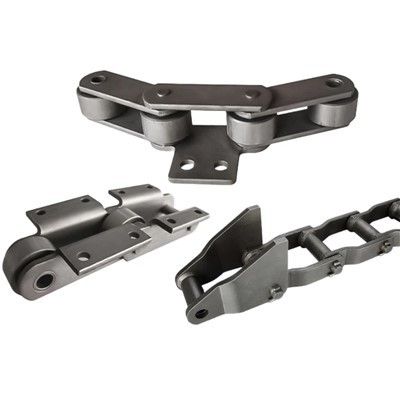
Hey there! As a supplier of Chain Plate Feeder Chains, I often get asked about the chain strength of these chains. So, let’s dive right in and talk about what chain strength really means for a Chain Plate Feeder Chain. Chain Plate Feeder Chain

First off, chain strength is super important. It’s what determines how well the chain can handle the daily grind of a feeder system. You see, a Chain Plate Feeder Chain is used in some pretty tough environments. Whether it’s in a mining operation, handling heavy ores and rocks, or in a manufacturing plant, moving large quantities of materials, these chains need to be up to the task.
The chain strength of a Chain Plate Feeder Chain is basically a measure of its ability to withstand different types of forces. There are a few key factors that contribute to this strength.
One of the most obvious ones is the material the chain is made of. We use high – quality steel alloys in our chains. These alloys are carefully selected for their high tensile strength. Tensile strength is the ability of the chain to resist being pulled apart. When the chain is moving heavy loads, there’s a lot of pulling force at work. If the chain’s tensile strength isn’t up to par, it could break, which would be a major headache for anyone using the feeder system.
Our steel alloys are also resistant to wear and corrosion. In those harsh industrial environments, chains are exposed to all sorts of rough substances and sometimes even corrosive chemicals. If the chain starts to wear down quickly, its strength will decrease, and it won’t be able to do its job effectively. Corrosion can also weaken the chain over time. So, by using these special alloys, we ensure that our chains stay strong for longer.
Another factor that affects chain strength is the design of the chain. The links in a Chain Plate Feeder Chain are carefully engineered. The shape and size of each link play a role in how the chain distributes the load. Our chains have links that are designed to evenly spread the weight of the materials being transported. This means that no single part of the chain has to bear too much stress.
The connection between the links is also crucial. We use high – quality pins and bushings to join the links together. These components are made to fit precisely, creating a strong and stable connection. When the chain is in motion, the pins and bushings need to be able to handle the constant bending and twisting forces without coming loose or getting damaged. If the connection between the links is weak, the whole chain’s strength can be compromised.
Then, there’s the matter of heat treatment. After the chains are manufactured, we put them through a heat – treating process. This process helps to improve the mechanical properties of the chain. It makes the chain harder and more ductile at the same time. Hardness is important because it allows the chain to resist abrasion from the materials it’s moving. Ductility, on the other hand, means that the chain can absorb some shock and deformation without breaking.
Let’s talk about how we test the chain strength. We have a bunch of tests in place to make sure our chains meet the highest standards. One of the most common tests is the tensile test. We take a sample of the chain and put it in a testing machine. The machine applies a pulling force to the chain until it breaks. By measuring the force at which the chain breaks, we can determine its tensile strength.
We also do fatigue tests. In real – world use, chains are subjected to repeated loading and unloading cycles. Fatigue tests simulate these conditions. We put the chain through a large number of cycles of stress and then check for any signs of damage or weakening. This helps us ensure that our chains can handle long – term use without failing.
Now, you might be wondering why all this matters to you. Well, if you’re in the market for a Chain Plate Feeder Chain, you want to make sure you’re getting a chain that’s going to last. A weak chain can lead to frequent breakdowns, which means downtime for your operation. And downtime can cost you a fortune in lost production and repair costs.
Our chains are designed with strength in mind. We’ve spent years perfecting our manufacturing processes and using the best materials to ensure that our chains are as strong as possible. Whether you need a chain for a small feeder system or a large – scale industrial operation, we’ve got you covered.
If you’re looking for a reliable Chain Plate Feeder Chain, don’t settle for anything less than the best. Our chains offer top – notch strength, durability, and performance. And we’re here to help you find the right chain for your specific needs.
If you’re interested in learning more or want to discuss a potential purchase, don’t hesitate to reach out. We’re always happy to have a chat and see how we can help you get the most out of your feeder system.
Sprocket References
- "Materials Science and Engineering: An Introduction" by William D. Callister Jr. and David G. Rethwisch
- Industry standards and guidelines for Chain Plate Feeder Chains
Zhejiang Hangte Chain Transmission Co., Ltd.
We are one of the most experienced chain plate feeder chain manufacturers and suppliers in China since 1999. Please rest assured to buy high quality chain plate feeder chain made in China here from our factory. If you have any enquiry about cooperation, please feel free to email us.
Address: No. 195 Qinglin East Street, Qingshan Lake Subdistrict, Lin’an District, Hangzhou City, Zhejiang Province
E-mail: hangtechain@gmail.com
WebSite: https://www.chinahtchain.com/
